Showing posts with label Aptitude. Show all posts
Saturday, 22 June 2019
Thursday, 20 June 2019
Aptitude Hack#117(20-6-19)
Question:
If A = x% of y and B = y% of x, then which of the following is true?
A)A is smaller than B.
B)A is greater than B
C)Relationship between A and B cannot be determined.
D)If x is smaller than y, then A is greater than B.
E) None of these
Answer: E) None of these.
Explanation:
x% of y = y% of x
As,
x% of y = x/100 of y.
y% of x = y/100 of x.
If A = x% of y and B = y% of x, then which of the following is true?
A)A is smaller than B.
B)A is greater than B
C)Relationship between A and B cannot be determined.
D)If x is smaller than y, then A is greater than B.
E) None of these
Answer: E) None of these.
Explanation:
x% of y = y% of x
As,
x% of y = x/100 of y.
y% of x = y/100 of x.
Wednesday, 19 June 2019
Aptitude Hack#116(19-6-19)
Question:
5, 10, 13, 26, 29, 58, 61,122, (....)
A. 120
B. 124
C. 125
D. 128
Answer: C) 125
Explanation:
Numbers are alternatively multiplied by 2 and increased by 3.
So, the missing number = 122+3=125.
5, 10, 13, 26, 29, 58, 61,122, (....)
A. 120
B. 124
C. 125
D. 128
Answer: C) 125
Explanation:
Numbers are alternatively multiplied by 2 and increased by 3.
So, the missing number = 122+3=125.
Sunday, 16 June 2019
Aptitude Hack#113(16-8-19)
Question:
Six bells commence tolling together and toll at intervals of 2, 4, 6, 8 10 and 12 seconds respectively. In 30 minutes, how many times do they toll together?
A. 4
B. 10
C. 15
D. 16
Answer: D) 16
Explanation:
L.C.M. of 2, 4, 6, 8, 10, 12 is 120.
So, the bells will toll together after every 120 seconds(2 minutes).
In 30 minutes, they will toll together
30/2 + 1 = 16 times.
Six bells commence tolling together and toll at intervals of 2, 4, 6, 8 10 and 12 seconds respectively. In 30 minutes, how many times do they toll together?
A. 4
B. 10
C. 15
D. 16
Answer: D) 16
Explanation:
L.C.M. of 2, 4, 6, 8, 10, 12 is 120.
So, the bells will toll together after every 120 seconds(2 minutes).
In 30 minutes, they will toll together
30/2 + 1 = 16 times.
Saturday, 15 June 2019
Friday, 14 June 2019
Thursday, 13 June 2019
Aptitude Hack#111(14-6-19)
Question:
Today is Monday. After 61 days, it will be:
A. Wednesday
B. Saturday
C. Tuesday
D. Thursday
Answer: B) Saturday
Explanation:
Each day of the week is repeated after 7 days.
So, after 63 days, it will be on Monday.
After 61 days, it will be on Saturday.
Today is Monday. After 61 days, it will be:
A. Wednesday
B. Saturday
C. Tuesday
D. Thursday
Answer: B) Saturday
Explanation:
Each day of the week is repeated after 7 days.
So, after 63 days, it will be on Monday.
After 61 days, it will be on Saturday.
Aptitude Hack#110(13-6-19)
Question:
Two pipes A and B together can fill a cistern in 4 hours. Had they been opened separately, then B would have taken 6 hours more than A to fill the cistern. How much time will be taken by A to fill the cistern separately?
A. 1 hour
B. 2 hours
C. 6 hours
D. 8 hours
Answer: C)6 hours
Explanation:
Two pipes A and B together can fill a cistern in 4 hours. Had they been opened separately, then B would have taken 6 hours more than A to fill the cistern. How much time will be taken by A to fill the cistern separately?
A. 1 hour
B. 2 hours
C. 6 hours
D. 8 hours
Answer: C)6 hours
Explanation:
Wednesday, 12 June 2019
Aptitude Hack#109(12-6-19)
Question:
A man buys eggs at 2 for Rs 1 and an equal number at 3 for Rs 2 and sells the whole at 5 for Rs 3. What's the percentage of gain or loss?
A) 27/7 % gain
B) 16/7 % loss
C) 23/7 % loss
D) 20/7 % gain
Answer: D) 20/7 % gain.
Explaination:
First Variety costs per egg: Rs. 1/2
Second Variety costs per egg: Rs.2/3
He sells all of them for Rs. 3/5. per egg
Let us consider he bought 30 eggs of each Variety. (Why 30? Well, we can consider any number it is just that LCM(2,3,5) which is denominators of our rates 1/2, 2/3, 3/5. Therefore with 30, our multiplication with them will be easier)
Since Price*Quantity=Expenditure
Total cost of First Variety = (1/2)*30=15
Total cost of Second Variety = (2/3)*30=20
The total cost of Both the Varieties= 15+20=35
He sells all of them for = (3/5)*(30+30)= 36
Here, CP=35 & SP=36
%Profit = (SP-CP)*100/CP
%Profit = (36–35)*100/35
%Profit = 100/35
So %Profit= 20/7%.
A man buys eggs at 2 for Rs 1 and an equal number at 3 for Rs 2 and sells the whole at 5 for Rs 3. What's the percentage of gain or loss?
A) 27/7 % gain
B) 16/7 % loss
C) 23/7 % loss
D) 20/7 % gain
Answer: D) 20/7 % gain.
Explaination:
First Variety costs per egg: Rs. 1/2
Second Variety costs per egg: Rs.2/3
He sells all of them for Rs. 3/5. per egg
Let us consider he bought 30 eggs of each Variety. (Why 30? Well, we can consider any number it is just that LCM(2,3,5) which is denominators of our rates 1/2, 2/3, 3/5. Therefore with 30, our multiplication with them will be easier)
Since Price*Quantity=Expenditure
Total cost of First Variety = (1/2)*30=15
Total cost of Second Variety = (2/3)*30=20
The total cost of Both the Varieties= 15+20=35
He sells all of them for = (3/5)*(30+30)= 36
Here, CP=35 & SP=36
%Profit = (SP-CP)*100/CP
%Profit = (36–35)*100/35
%Profit = 100/35
So %Profit= 20/7%.
Monday, 10 June 2019
Aptitude Hack#108(11-6-19)
Question:
A drinks machine offers three selections - Tea, Coffee or Random but the machine has been wired up wrongly so that each button does not give what it claims. If each drink costs 50p, how much minimum money do you have to put into the machine to work out which button gives which selection?
(A) 5 rupees
(B) 10 rupees
(C) 25 rupees
(D) Infinity
Answer: A) 5 rupees
Explaination:
Each button does not give what it claims. So tea button may give coffee or random (either tea or coffee) and coffee bottom may give tea or random (either tea or coffee).
The random bottom should give either coffee or tea. If we start with this random button with one 5 rupees coin, then it will work for either tea button providing tea or for coffee button providing coffee.
If the random button works for tea, then the tea button must be for coffee or random. As the already random button is for tea, the coffee button cannot be tea, and hence random.
Thus,
random = tea, coffee = random, tea = coffee.
Similarly, if the random button gives coffee while we put 5 rupees coin, then
random = coffee, tea = random, coffee = tea
Thus by 1st chance only we can found out which button works for which selection with minimum money of 5 rupees only
A drinks machine offers three selections - Tea, Coffee or Random but the machine has been wired up wrongly so that each button does not give what it claims. If each drink costs 50p, how much minimum money do you have to put into the machine to work out which button gives which selection?
(A) 5 rupees
(B) 10 rupees
(C) 25 rupees
(D) Infinity
Answer: A) 5 rupees
Explaination:
Each button does not give what it claims. So tea button may give coffee or random (either tea or coffee) and coffee bottom may give tea or random (either tea or coffee).
The random bottom should give either coffee or tea. If we start with this random button with one 5 rupees coin, then it will work for either tea button providing tea or for coffee button providing coffee.
If the random button works for tea, then the tea button must be for coffee or random. As the already random button is for tea, the coffee button cannot be tea, and hence random.
Thus,
random = tea, coffee = random, tea = coffee.
Similarly, if the random button gives coffee while we put 5 rupees coin, then
random = coffee, tea = random, coffee = tea
Thus by 1st chance only we can found out which button works for which selection with minimum money of 5 rupees only
Aptitude Hack#107(10-6-19)
Question:
If there are 51 rupees consisting of coins of 1 rupee, 50 paise, and 25 paise. Number
of 50 paise coin is double that of number of 1 rupee coin and four times that of 25
paise, and then what is the number of 50 paise coins in the collection.
(A)48
(B)51
(C)12
(D)24
Answer: A) 48
Explaination:
If there are 51 rupees consisting of coins of 1 rupee, 50 paise, and 25 paise. Number
of 50 paise coin is double that of number of 1 rupee coin and four times that of 25
paise, and then what is the number of 50 paise coins in the collection.
(A)48
(B)51
(C)12
(D)24
Answer: A) 48
Explaination:
Aptitude Hack#106(9-6-19)
Question:
Mr. Das decided to walk down the escalator of a mall. He found that if he walks down
26 steps, he requires 30seconds to reach the bottom. However, if he steps down 34
stair He would only require 18 seconds to get to the bottom. If the time is measured
from the moment the top step begins to descend to the time he steps off the last step
at the bottom, find out the height of the stairway insteps?
(A)46
(B)35
(C) 56
(D)55
Mr. Das decided to walk down the escalator of a mall. He found that if he walks down
26 steps, he requires 30seconds to reach the bottom. However, if he steps down 34
stair He would only require 18 seconds to get to the bottom. If the time is measured
from the moment the top step begins to descend to the time he steps off the last step
at the bottom, find out the height of the stairway insteps?
(A)46
(B)35
(C) 56
(D)55
Saturday, 8 June 2019
Friday, 7 June 2019
Thursday, 6 June 2019
Aptitude Hack#103(6-6-19)
Question:
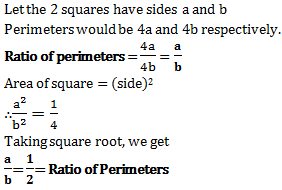
If the ratio of the areas of two squares is 1:4, the ratio of their perimeters is
A. 1:2
B. 1:4
C. 1:6
D. 1:8
ANSWER: A) 1:2
Explanation:

If the ratio of the areas of two squares is 1:4, the ratio of their perimeters is
A. 1:2
B. 1:4
C. 1:6
D. 1:8
ANSWER: A) 1:2
Explanation: